Yet another reading and early learning report has reconfirmed the urgent call to action. When Finance Minister Enoch Godongwana tables his “mini-budget” in parliament on Wednesday, will funding be unlocked to deliver national development and poverty-reduction promises?
South Africa faces a severe literacy crisis that impacts poorer communities most. Yet another gloomy study, this time by Roots and Shoots, exposes, once again, the stark inequality gap: while 92% of children at mid-fee schools reach Grade 3 reading benchmarks, under 50% achieve this at no-fee and low-fee schools.
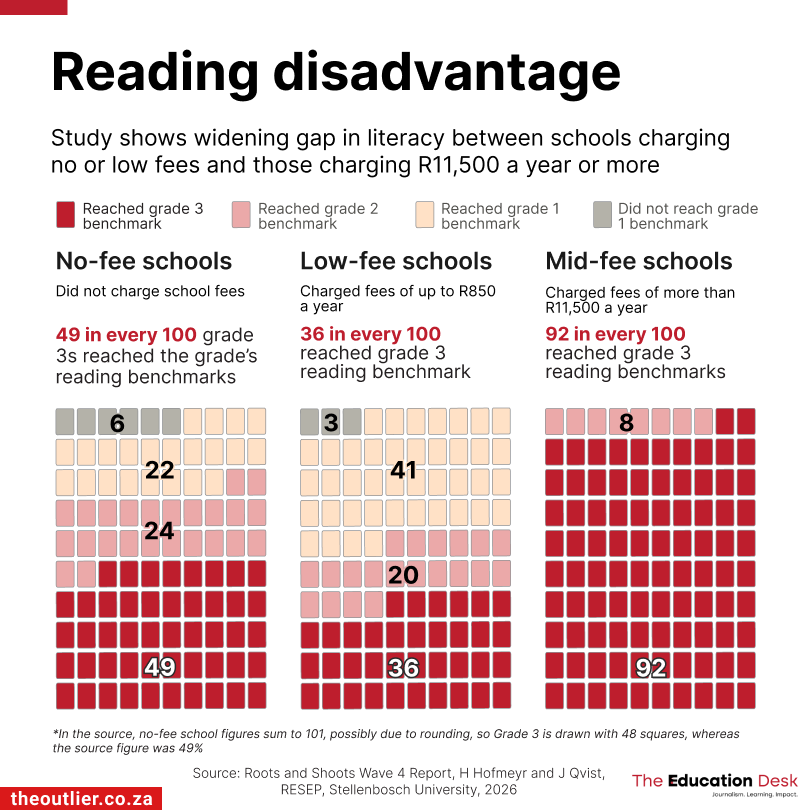
The study also confirms that the Foundation Phase (Grades 1–3) fails to act as an equalising stage, instead amplifying prior disadvantages and leaving vulnerable learners behind. While Early Childhood Development (ECD) must be prioritised, urgent interventions are also needed at the foundation school level to close the gap.
These findings echo benchmark literacy surveys like the 2025 Funda Uphumelele National Survey (FUNS), which tracked early grade reading assessments across all 11 official languages. It found that 80% of Grade 4 learners cannot read for meaning, with an alarming 15% of Grade 3s scoring zero.
Finance Minister Enoch Godongwana tables the Medium-Term Budget Policy Statement (MTBPS) next Wednesday. The education sector will be watching closely, with civil society and communities hoping that expert research and tomes of reports will translate into realisable support.
The “mini-budget” — which reviews spending and allows departments to adjust allocations and request funds for unforeseen expenditures — is under pressure to consider multiple national crises, all while working with a limited pot of public funds. Increased demand for relief amid unprecedented hikes in the petrol price has aggravated the pressure, affecting every sector, including scholar transport.
Early interventions are now recognised as a bedrock of national development and poverty reduction goals, so let’s see if the Department of Basic Education (DBE) will secure critical funding to deliver on its 2026/27 Budget theme “Strong Foundations for Strong Futures”. Key reforms include supporting foundational learning, improving teacher accountability, and expanding access to quality ECDs.
In our launch months, EdDesk has reported on some of the pressing accountability challenges. Key questions ahead of the MTBPS include:
- ECD & Grade R: Following a record-breaking year with over 13,300 registered ECD centres, will the budget fund their formal integration, and resource schools for the mandatory Grade R transition under the Basic Education Laws Amendment (BELA) Act?
- Child Stunting and nutrition: Will Treasury allocate funds to fulfill presidential pledges aimed at eradicating stunting, which puts children on an unequal footing from the get-go?
- Infrastructure: Will funding be released to tackle the staggering R140-billion infrastructure backlog?
- Teacher assistant programme: Following a R24 billion Treasury appeal in July, will the Minister greenlight the Basic Education Employment Initiative (BEEI), a vital school job-support programme in which more than one million young assistants were placed in schools over five years, but which stalled amid a funding hiatus?
South Africans are all too aware that fixing education is not solely dependent on finances. But next week’s MTBPS – tabled just weeks before South Africans head to the polls for local elections – will measure whether the government’s foundational commitments and 2030 national growth goals are backed by the basic fiscal framework required to deliver them.
Sign up to EdDesk’s fortnightly newsletter and get this column in your inbox: Click here