
ATLANTIS: Stitch by stitch, a teacher in Atlantis outside Cape Town is using his self-taught sewing skills to repair learners’ torn uniforms – which in turn builds confidence and participation in class.
A torn school uniform may seem like a small problem, but teacher Sonwabile Gana noticed that for some learners, it was a barrier to confident participation in the classroom.
Learner write on the whieboard while Sonwabile Gana repairs torn uniforms during break time at Witsand Primary School in Atlantis. 28 August 2026. Photo: Shelley Christians/EdDesk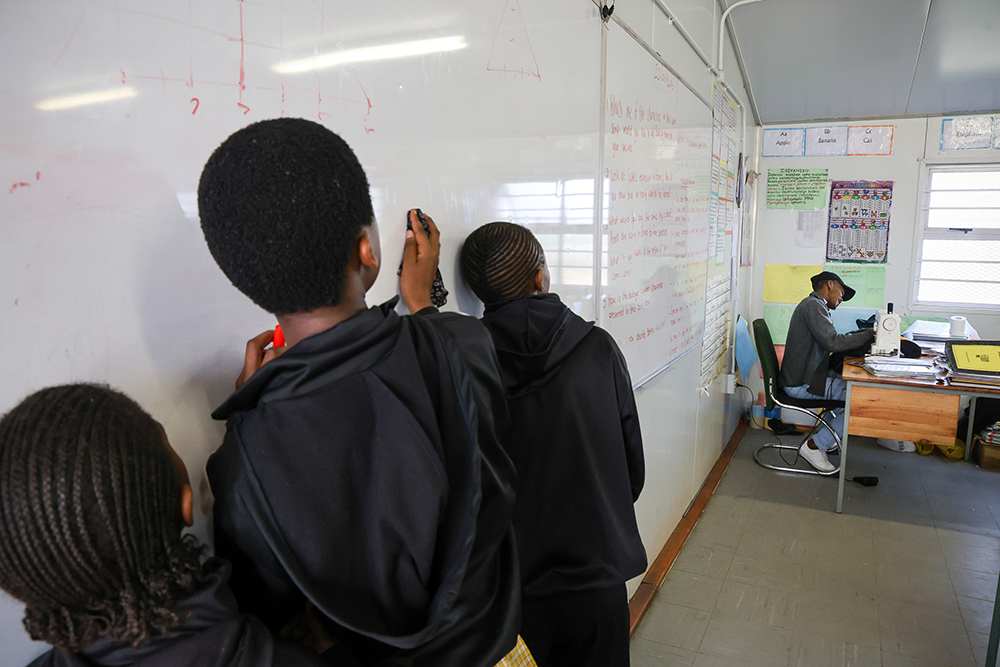
For Gana, a teacher at Witsand Primary School in the greater Atlantis area, the solution was sitting at home: a sewing machine he had bought himself as a hobby.
So he brought his sewing skills into the classroom and started repairing his learners’ uniforms for free.
I want them to have a fighting chance, to see beyond their torn clothes. They must imagine a future of possibilities.
“I had a sewing machine at home and had trained using tutorials online,” Gana told EdDesk.
The learners’ hardships reminded him of his own childhood and the effect poverty can have on a child’s experience of school.
Witsand Primary is made up of prefabricated school buildings in Atlantis. 28 August 2026. Photo: Shelley Christians/EdDesk Keywords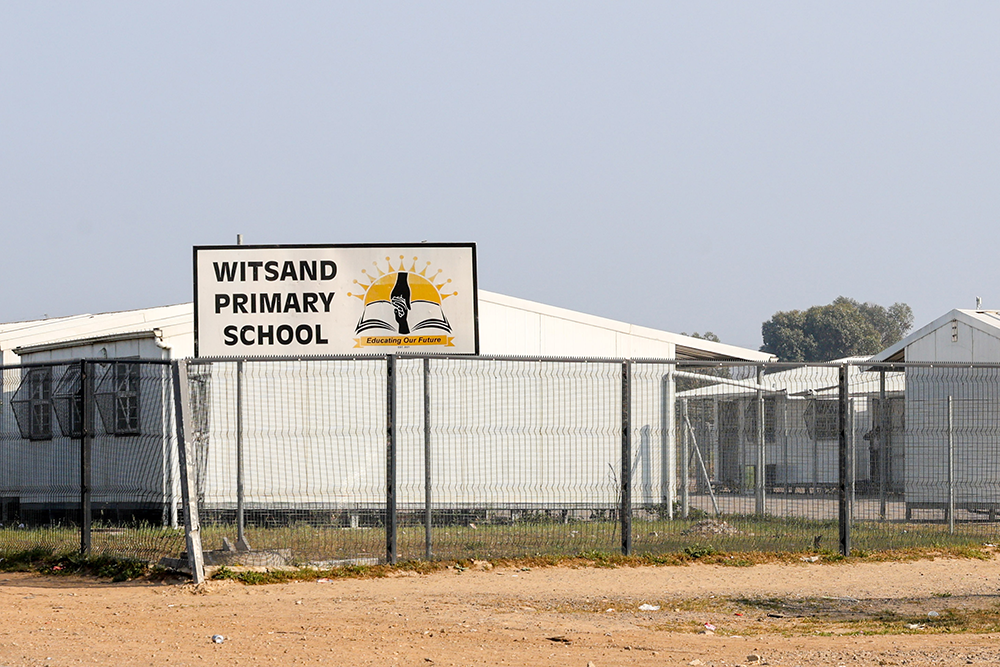
“I went to school barefoot and have friends who never finished school due to torn uniforms,” he said.
“The age group I am teaching is at the discovery stage and they are self-aware. It is important to protect them so that they do not feel less as children.”
Gana, 34, teaches Grades 5 to 7. He joined the school in April last year and initially mended uniforms only for learners in his own class.
“I used to ask them why they came to school with torn uniforms, and they would say that their parents did not have money for a sewist,” he said.
What began with about eight items a week has grown to roughly 13 as other teachers have become aware of his sewing skills.
His colleagues now identify children in their classes whose uniforms need attention and send them for repair.
When EdDesk visited the school last Friday, a pile of uniforms was waiting for Gana.
He fits the sewing around his teaching responsibilities. Between lessons, during breaks, and after the final school bell has rung, Gana repairs torn seams and stitches up hems.
Learners return to school after their break at Witsand Primary School in Atlantis. 28 August 2026. Photo: Shelley Christians/EdDesk Keywords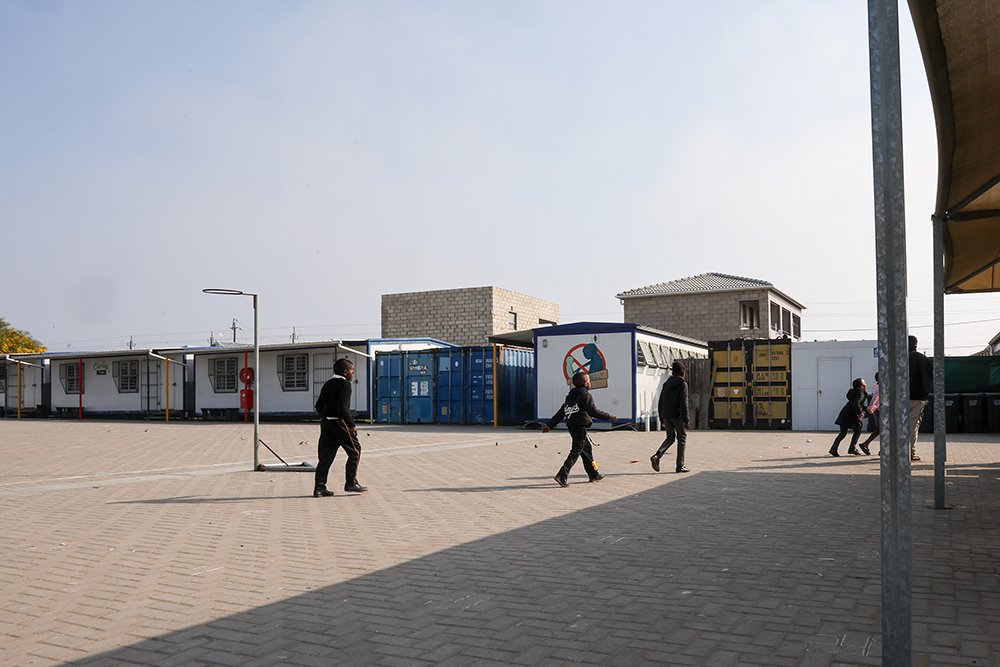
“I use my free time during break and especially Fridays because school finishes early. As teachers, we remain at school for another hour after the learners have gone home, and I use that time to sew,” he said.
Sometimes, the pile is too big to finish at school, and he takes his sewing machine and uniforms home for repair.
The sewing machine attracts an audience at school. Learners gather around Gana, smiling as they watch the needle move through the fabric, bringing together ripped seams and repairing damaged clothing. “I enjoy doing this,” he said. “My colleagues are supportive.”
For Gana, repairing a uniform is about more than making a shirt, pair of trousers or dress wearable again. He believes the condition of a child’s clothing can influence how they see themselves and how confidently they participate at school.
His own journey to the classroom was unconventional. Before becoming a teacher, Gana was a taxi driver. His interest in teaching developed while he was occasionally asked to stand in for an absent teacher at Umyezo wama Apile High School in Grabouw.
Those experiences changed the direction of his life. He enrolled for a teaching degree at the Cape Peninsula University of Technology and began his teaching career in 2020.
Today, the married father of two travels from Delft, which is 64 kilometres away, to teach at Witsand Primary.
Witsand forms part of the greater Atlantis area, about 45km north of Cape Town’s city centre. The community includes formal and informal housing, while the school itself operates from temporary classrooms.
Gana encounters families for whom replacing a damaged school uniform or paying someone to repair it is not always an option.
He hopes parents or other community members with sewing skills will volunteer their time to help as demand grows.
His motivation goes back to the support he received as a child. “I was fortunate because I had grandparents who supported me and could see beyond the schooling years. This is what I wish for these children,” he said.
“I want them to have a fighting chance, to see beyond their torn clothes. They must imagine a future of possibilities.
“I do not have the money to buy them new uniforms, but I have a sewing machine to help them.”