
CAPE TOWN: Finland’s education minister, who is visiting South Africa this week, says a year-long restriction on cellphone use in schools has already transformed the way children learn in class, and how they interact at break times instead of staring at their phones.
Finland’s restrictions on cellphone use in schools have transformed the way children learn and interact, with school breaks once again filled with conversations, games and physical activity instead of sitting on their phones, according to Education Minister Anders Adlercreutz.
The changes have been noticeable, he said. “It’s much calmer during the classes.”
Speaking exclusively to EdDesk during a working visit to South Africa, Adlercreutz said the stringent restrictions, introduced a year ago, were driven by growing concerns about children’s ability to concentrate and focus in an increasingly digital world.
Via the Minister, Finland – one of the wealthiest countries, with free public education from pre-primary up to higher education – offered to strengthen cooperation with South Africa in areas including early childhood development, teacher development, mother-tongue-based bilingual education and equipping learners with future-ready skills.
The constant stream of short-form digital content was contributing to a broader decline in children’s ability to engage with slower and more demanding activities such as reading and learning.
“We are all losing the ability to concentrate, to focus,” Adlercreutz said. “But for children, it’s even more challenging.”
Finland introduced restrictions on cellphone use in primary and high school during lessons, while schools were given discretion over whether to extend the ban to breaks.
Adlercreutz said many schools have chosen to enforce a cell-phone-free break time, and teachers have reported significant changes in how children spend those periods.
“The breaks are now full of noise,” he said. “People are not sitting in front of their phones. They are playing together, they are discussing, they are playing cards, they are playing board games, they are playing basketball and football again.”
Adlercreutz said the restrictions had won support from learners themselves, including some who initially opposed the policy. “What’s most positive is that it’s not only the teachers and parents that like this legislation, but also the kids,” he said. “There were some doubts about the legislation beforehand, but nowadays nobody doubts it. It’s uniformly praised.”
For Adlercreutz, the restrictions are not simply about reducing children’s screen time. He believes schools increasingly have a responsibility to teach children how to slow down and tolerate boredom. “One of the tasks of our schools nowadays is to teach the kids to be slow, and at times also to bear boredom,” he said.
He argued that the ability to concentrate for sustained periods will become even more important as technology, including artificial intelligence, reshapes education and the workplace.

A Grade 1 pupil at Tamboerskloof Primary School in Cape Town. Photo: Shelley Christians/EduDesk
“We need to understand the digital world. We need to understand artificial intelligence; we need to be technologically proficient and literate,” he said. “But we also need to be able to focus and dig deep into things and learn complex questions.” That, he said, requires sustained concentration.
Adlercreutz rejected the idea that limiting cellphone use conflicts with Finland’s embrace of technology. Children need to understand and use new technologies, he said, but they must also be able to disconnect and engage deeply with subjects without constant digital interruption.
The ban was not a temporary response to concerns about children’s behaviour. “It’s permanent,” he said, adding that Finland was among the first countries in Europe to introduce such legislation.
For Finland, the restrictions are part of a broader attempt to balance technological literacy with what Adlercreutz describes as the increasingly important ability to be still, concentrate.
Teachers have Master’s
Finland has one of the best education systems in the world, with the minister saying that most, if not all, teachers have a Master’s degree, and learners have early access to education.
The profession is thus competitive and sought-after, with only a small number of applicants being accepted into the profession, he said.
The journey towards excellence dates back to 1917, with local municipalities now running schools, with the national office providing support and oversight.
The Minister’s comments come amid a tightening of access to cellphones globally, and also of social media. In terms of platforms. Australia was first out of the starting blocks in December, introducing a total ban on social media for children under 16.
Cellphones and South African schools
In South Africa, there is no single national law prohibiting cellphone use in all schools. Instead, schools and School Governing Bodies generally determine their own policies on electronic devices.
Camps Bay High School in Cape Town is among the schools that have imposed stricter restrictions, introducing a cellphone ban this year, where devices are placed in lockers during the school day.
The South African government has been considering how best to respond to children’s growing exposure to digital platforms. In February, speaking to EWN, Communications Minister Solly Malatsi said the government was monitoring international developments and considering the “best approach”, while warning against measures that could not be effectively enforced.
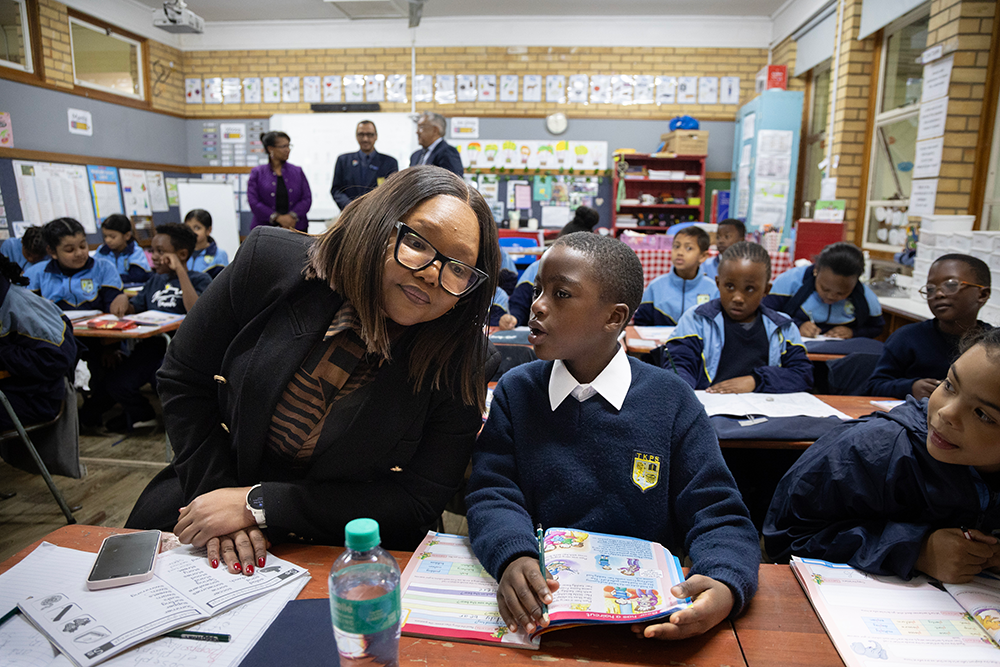
Basic Education Minister Siviwe Gwarube talks to a Grade 1 pupil at Tamboerskloof Primary. 17 August 2026. Photo: Shelley Christians/EdDesk
Basic Education Minister Siviwe Gwarube, who was present during engagements with Adlercreutz, said they are taking lessons from countries like Finland. She has also worked to overhaul the department from focusing largely on matric results. “Our view has been to focus squarely on how we strengthen the foundation of learning because we believe a stronger foundation will be able to transform the education system.”
Adlercreutz. who also met Deputy Minister of Higher Education Dr Nomusa Dube-Ncube and visited Tamboerskloof Primary School and Northlink College, said South Africa was on the right track and they too can learn from the country’s diversity and education system.
This article by The Education Desk was also published by News24.