
CAPE TOWN: The Eastern Cape began ordering Grade 1 to 3 learning materials from the new R1.6 billion Foundation Phase National Catalogue this week, while the Western Cape is holding off until procurement concerns are resolved.
The Eastern Cape has started ordering grade 1 to 3 learning materials from the new R1.6-billion Foundation Phase National Catalogue ahead of the 2027 school year, while the Western Cape is holding off until procurement concerns are resolved.
The textbooks and other materials are expected to be based on the latest research to improve literacy in line with the National Literacy Strategy and Plan 2024–2030. More than 80% of grade 4 learners were found to be unable to read for meaning in any language in the 2021 Progress in International Reading Literacy Study.
The Eastern Cape acknowledged the ”limited timeframe” and was prioritising procurement from the start of the fourth term this week.
“The Eastern Cape Department of Education (ECDoE) confirms that it intends to procure grade 1 to 3 learning and teaching support materials from the new Foundation Phase National Catalogue,” said department spokesperson Malibongwe Mtima.
The provincial department acknowledged the “limited timeframe” and said it would prioritise procurement this week from the new catalogue, following months of uncertainty over the process.
After investigations into the tender process led to reviews and suspensions, the minister approved the new catalogue in late September but added that “lawful correction” still needs to take place.
The Department of Basic Education (DBE) confirmed that procuring authorities – schools and provinces – were responsible for ensuring legal compliance.
This led the Western Cape to opt out of the new catalogue for 2027. “We are erring on the side of caution until these matters are sufficiently addressed and will continue with the plans we already had in place,” said Western Cape Education Department (WCED) MEC Jaco Londt.
The WCED has already provided teaching and learning support materials to all classes for the 2027 year and has expanded the pre-existing catalogue to include decodable graded readers, enabling schools to access reading materials through its Back on Track programme.
“In addition, the WCED has developed and co-created a range of reading resources that are already being used in schools and will continue to be available in 2027,” Londt said.
“These include department-developed and open-source reading materials that align with the department’s approved reading approach. All reading materials currently used by the WCED have been reviewed and screened to ensure alignment with curriculum and procurement requirements.”
Timing is critical as provinces decide on required materials, complete procurement, and deliver books in time for the new school year in January. The Free State said officials are holding “daily virtual meetings”, while other provinces are still in talks with the national department.
Terence Khala, national DBE spokesperson, said, “Procurement decisions are made by the respective provinces, and their processes are at different stages. For this reason, it would be premature to provide a definitive list of provinces that will or will not procure from the catalogue.”
The ECDoE said it would only select material from approved publishers. “No order will be deliberately placed where there remains an unresolved compliance concern that could render the procurement irregular or unlawful,” the ECDoE said. But it could not yet say whether any publishers or titles would be excluded because of deficiencies.
Eastern Cape to rely on DBE compliance checks
The ECDoE said it would only select approved publishers, as confirmed by the national DBE. “No order will be deliberately placed where there remains an unresolved compliance concern that could render the procurement irregular or unlawful,” the department said. However, it could not yet say whether any publishers or titles would be excluded because of deficiencies.
Officials plan to monitor requisitioning, consolidation, ordering, supply and delivery, while engaging with the DBE, districts, schools, publishers and service providers to resolve outstanding problems. Any delay in confirming which publishers have rectified deficiencies could eat into the time available for orders, printing and delivery.
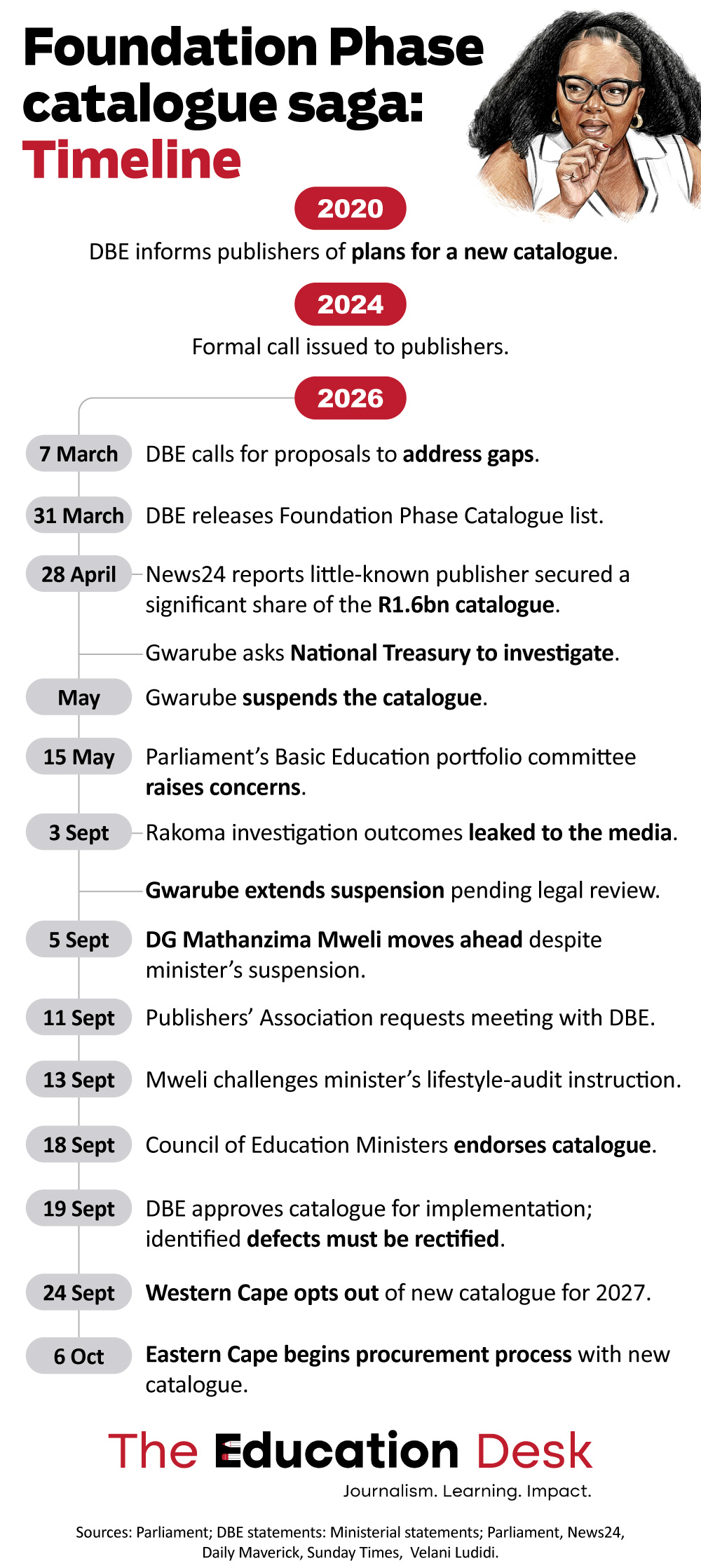
How the catalogue saga unfolded
The R1.6-billion catalogue’s troubled path began in April, after News24 reported that Lighthouse Publishers, a little-known company with no prior publishing track record, was to be paid R285-million for about 26% of all 6,385 titles approved across the catalogue’s 19 publishers. This was more than any other single publisher. News24 reported that Lighthouse had been registered only days after the tender’s terms of reference were issued.
The reports prompted Minister Siviwe Gwarube to request an investigation in late April. When that review was inconclusive, Gwarube suspended the catalogue and announced an independent external investigation on 26 May.
That probe was later broadened to examine all entities involved in the catalogue. In September, Gwarube extended the suspension after the investigation flagged “material areas of noncompliance, governance weaknesses and potential procurement and financial management risks” across the process.
Following a meeting of the Council of Education Ministers, the DBE announced on September 19 that the catalogue had been approved, subject to legal defects that required fixing.
The legal reports and investigations have not been officially released to the public.
No specific finding has been made publicly against Lighthouse, which did not respond to our questions by the time of publication.
This article by EdDesk was also published by GroundUp.