
OPINION: South Africa’s unemployment rate stands at 33.6%, according to the latest Quarterly Labour Force Survey, with the youth jobless rate rising to over 47%. How do we turn things around? Coinciding with a visit to South Africa by Finland’s Education Minister, a decade-long Finnish-South African university collaboration looks at vocational teacher education to provide some solutions.
Persistent graduate unemployment and a widening skills gap continue to hamper South Africa’s economic growth. In his 2026 State of the Nation Address,, President Cyril Ramaphosa emphasised aligning vocational education with the realities of the workplace – a priority echoed by Higher Education and Training Minister Buti Manamela in his budget speech.
There is little question that South Africa must forge its own solutions. However, examining international practices can help identify approaches that may be adapted to local circumstances rather than copied wholesale.
Finland is involved in an aspect of work-relevant vocational education where sustained investment in vocational teacher education has helped create a system that is both responsive to the needs of employers and centred on student learning.
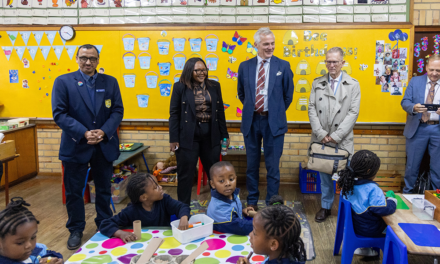
Learners at Tamboerskloof Primary School in Cape Town welcome Finland’s Minister of Education, Anders Adlercreutz. 17 August 2026. Photo: Shelley Christians/EduDesk
For the past ten years, Tshwane University of Technology (TUT) has collaborated with Finland’s Haaga-Helia University of Applied Sciences to rethink professional teacher education. As Finnish Minister of Education Anders Adlercreutz meets Minister Manamela in Cape Town next week, three key lessons from this partnership stand out for South Africa.
Lesson 1: Equity and access help keep the focus on what matters. South Africa and Finland may be very different, but both share a belief that education should create opportunities and open doors. This shared commitment to equity and access has underpinned the partnership between TUT and Haaga-Helia for more than a decade. It has also helped ensure that discussions about teaching, technology and curriculum ultimately remain centred on learner success. The collaboration has been built on trust and mutual respect rather than the assumption that one side has all the answers. By combining Finnish experience with South African realities, lasting improvements in education are most likely when innovation is guided by a clear commitment to expanding opportunities for all.
Lesson 2: Learner-centred and practice-oriented approach is a good fit This approach recognises that learners come with different levels of prior knowledge, interests, learning needs and career aspirations. Teachers are therefore encouraged to develop flexible learning activities that allow students to progress at their own pace while engaging with tasks that reflect authentic workplace situations.
A key strength of the Finnish system is the vocational teacher. In Finland, vocational teachers are typically recruited only after gaining substantial experience in their own profession and then complete specialised pedagogical training before entering the profession, or alongside their teaching duties. This combination of occupational expertise and teaching competence helps ensure that learning remains closely connected to the realities of working life. Close collaboration between education providers and employers in curriculum development, skills assessment and workplace learning further helps programmes evolve alongside changes in industry.
While learner-centred education is sometimes viewed with suspicion in South Africa, where the traditional model often places the teacher at the centre of the classroom, participants in our programmes consistently describe the experience as transformative. Learner-centred education does not mean that teaching is organised according to learners’ preferences or demands. Rather, it is based on the understanding that individuals learn from different starting points, with different needs, experiences and aspirations. In this approach, learners are regarded as active participants, while teachers retain responsibility for the pedagogical design, guidance and assessment of learning.
Learner-centred education therefore combines active student engagement with strong pedagogical leadership from the teacher. In addition, this approach highlights the benefits of workplace learning. It demonstrates that meaningful preparation for employment can be achieved by combining classroom learning with shorter, more flexible workplace placements, while ensuring that educational institutions and their teachers remain responsible for guiding the overall learning process. In a context where opportunities for long-term apprenticeships and internships are not always available, this model may offer a practical and scalable alternative.
Lesson 3: Digital technologies should not be an add-on. Digital technologies are transforming almost every occupation, and need to be integrated into teaching and learning. However, effective digital education is not primarily about acquiring the latest devices or software. It is about equipping teachers with the confidence and pedagogical skills to use technology purposefully.
Throughout our collaboration, digital pedagogy has been an integral part of teacher education rather than a separate topic. Participant feedback has consistently shown that many South African teacher educators found these components particularly eye-opening, as they demonstrated practical ways to make learning more engaging, flexible and relevant without requiring expensive technological solutions. The lesson is that investing in teachers’ digital competence is at least as important as investing in digital infrastructure.
The priorities outlined by Ramaphosa and Manamela this year demonstrate a renewed commitment to ensuring that vocational education equips young people with relevant skills. Translating this vision into lasting impact will require continued investment across the system, including professional development for vocational teachers. Our decade-long collaboration has shown that while no education system can simply be copied from another country, international partnerships can help identify ideas worth adapting to local circumstances.
As the Ministers of South Africa and Finland meet next week, we hope vocational teacher education will remain firmly on the agenda. Investing in teachers is one of the most effective ways to ensure that vocational education equips young people to thrive in a changing world of work.
Prof. Barend J van Wyk is Deputy VC, Teaching, Learning and Technology, Tshwane University of Technology;
Amelia Vuyokazi Rorwana is Manager: University Capacity Development Programme, TUT; and Dr. Crister Nyberg is Director of Professional Teacher Education at Haaga-Helia University of Applied Sciences in Finland.
This article is published as a partnership with The Education Desk, an independent non-profit newsroom dedicated to addressing schooling challenges in South Africa.