JOHANNESBURG: Parliament’s oversight committee has trashed a progress report by the Mpumalanga Department of Education, instructing it to return with evidence of action taken to address problems identified at schools.
MPs in the Basic Education Portfolio Committee on Tuesday shut down the department’s presentation by the Mpumalanga education MEC Lindi Masina, saying responses to the committee’s oversight visit recommendations were “vague, unsupported and did not show whether conditions” had improved.
The committee’s demand followed an oversight visit by MPs to 10 institutions – a primary school, four secondary schools, three special-needs schools and two Early Development Centres in Ehlanzeni and Bohlabela in April.
The eight schools are: Matthews Phosa College, Lekazi Central Secondary School, Phambanisa Primary School, Nkomazi High School, Mahhushe Agricultural Secondary School, Kamagugu Special School, Tsakane Special School and Silindokuhle Special School. The two ECD centres visited are Msholozi Early Bird Day Care Centre and Nkomazi Siphumele Day Care Centre.
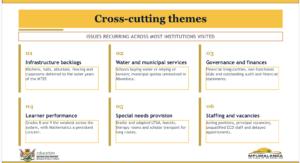
Following their visit, the MPs identified unreliable water supplies, overcrowded classrooms, sanitation and maintenance backlogs, unsafe infrastructure as the most urgent areas that needed attention. In the special needs schools, they raised concerns around the shortages of specialist staff and assistive devices.
The committee set deadlines for interventions, including filling vacant posts within 90 days and addressing classroom, water and ablution shortages before the end of the third term.
During Tuesday’ virtual meeting, committee chair Joy Maimela criticised the department for sending the report to the committee at the last minute. “The committee received Mpumalanga’s report and six attachments only last Thursday, with an updated version arriving on Tuesday morning before the meeting.”
This is despite procedural protocols expecting departments to share documents with the committee at least seven working days before a meeting to ensure preparedness.
The provincial department had not provided evidence that the structures existed or were functioning, leaving MPs unable to establish how outstanding work was being tracked.
“We have to postpone this meeting to give the province another opportunity to redo the report because, according to this report, some infrastructure and service-delivery interventions had been shifted to the next financial year without clear budgets, timelines or implementation plans,” Maimela said.
She said the committee required details of investigations, findings, consequence management and measures taken to prevent the problems from recurring. This was not included in the report.
In response, Masina, who was due to present the report, apologised for the weaknesses in the submission and acknowledged that it had not met the committee’s expectations.
Masina said the absence of a formal closeout session after the committee’s three-day oversight visit had contributed to difficulties in preparing the response, but said the department would return with a more comprehensive report.
MPs wanted evidence of remedies after incorrect or inappropriate materials were supplied and whether action had been taken against responsible officials or service providers.
“Simply showing that items had been procured or delivered did not establish whether learners had received the materials they needed,” Maimela said
The department also failed to satisfy the committee about responses to persistent water shortages. Some schools continued using portions of their budgets to secure water because municipal supply remained unreliable, but the province did not provide evidence of agreements with municipalities to address the problem.
Maimela questioned why money intended for educational and operational needs was being spent on water because of failures elsewhere in the system.
She also wanted future reports to show whether the department’s interventions had produced measurable improvements, including in learner performance, instead of merely listing activities.
ANC chief whip Pretty Xaba-Ntshaba called on the department to take MPs “seriously” and called for stricter standards against provinces that failed to implement the committee’s recommendations.
MK Party MP Siphetho Mkhize demanded an explanation for each recommendation that remained outstanding and called for the committee to show greater “teeth” in holding provincial governments accountable.
ActionSA whip Lerato Ngobeni called for the deficient presentation to be made public so people could see where the department had failed.
DA MP Ciska Jordaan and Ngobeni said Parliament could not enforce strict standards against some provinces while accepting inadequate responses from others.
The committee ordered Mpumalanga to return with a revised report responding separately to every recommendation. It needs to include what has been implemented, what remains outstanding, why recommendations were not carried out and when the work will be completed. The department was ordered to also identify obstacles that prevented implementation.
After conducting parliamentary State-of-schooling oversight visits to all provinces earlier this year. Mpumalanga was the second province to be called – after Limpopo – to present provincial progress reports as part of the committee’s follow-up engagements.
This article by The Education Desk was also published in Sowetan.