
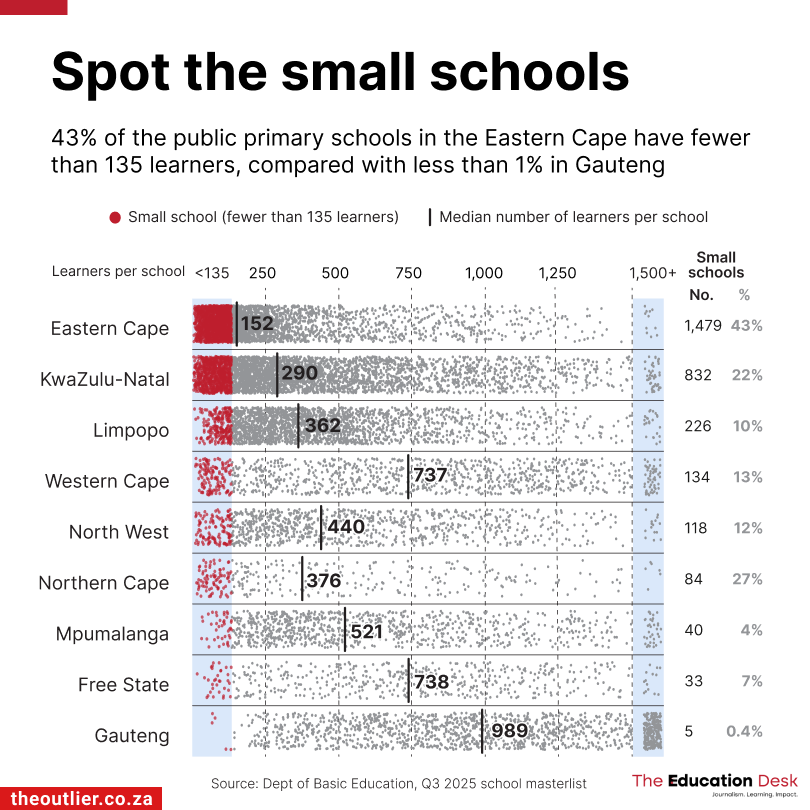
The size of the school may impact on the quality of education a learner receives. Those attended by children from affluent backgrounds can facilitate more focused attention from teachers. But sometimes it can be a disadvantage.
Research by the Department of Basic Education found that on average, public primary schools with fewer than 135 learners – categorised as ‘micro’ in the school norms and standards regulations – have worse academic outcomes and more dilapidated infrastructure than larger schools. This explains the government’s current emphasis on closing small schools.
Many small schools are in deep rural, poor areas. In the Eastern Cape, about four in10 primary schools are micro. In these schools, multiple grades are often taught in one classroom, placing a heavy burden on teachers; infrastructure is also often in poor condition, particularly water and sanitation.
The research found that 77% of micro primary schools have multigrade classes and 45% were in a severe state of infrastructure disrepair.
In some provinces, like the Free State, Mpumalanga, Northern Cape and North West, there has been a substantial drop in the percentage of micro schools. In the Eastern Cape, about 40% of primary schools have consistently been small.
Closing small schools can be very disruptive, particularly if there isn’t an alternative school nearby. It’s not feasible to close all small schools, so some will need to continue to be supported, notes the DBE research.
Source: Small Schools in SA: Infrastructure, Educational Outcomes, and the impact on learners when schools are closed, January 2025 (submitted as a Parliament response).